In the dappled light of the forest’s edge, He struts, wary, along the bramble’s ledge. His ruby throat, a beacon of flame, Bobs and flickers, untamed, untamed.
Eyes wide with a primal, ancient fear, Each rustle of leaves, each sound draws near. A breeze, a shadow – he freezes, tense, A sentinel poised by a fragile fence.
Down the road, domestic birds parade, Fat and oblivious, in sun-spotted shade. Their fates are sealed, their end well-known, But his is a dance in the wild alone.
Will he endure the frost-kissed nights, And coyotes’ teeth that gleam in moonlight? Or will his feathers scatter, a fleeting trace, Of a noble life in a ruthless place?
No table awaits his wary kind, No cranberry sauce, no sage entwined. Yet the woods hold stories cruel and raw, Where survival bends to nature’s law.
I spied this wild turkey standing alone on my walk today. I have always seen him with his mate and worry that the coyotes may have taken her from him. I hope he can find a good hiding spot in the woods tonight!
On Hallowe’en, the earth bears gifts of gold, Pumpkins swell, the squash begins to fold.
The harvest yields its bounty rich and bright, And I give thanks beneath the autumn light.
But as I walk, the shadows start to creep, And whisper secrets that the dark can keep.
For Samhain stirs, the Celtic year’s rebirth, Where ghosts and goblins rise from out the earth.
My mind, so tethered to the harvest’s might, Now feels the phantoms in the night.
The rational speaks of grain and seed, But still, the restless spirits sow their greed.
A headless rider gallops through the gloom, While witches weave their spells beneath the moon.
I walk between these worlds, both rich and strange – The earth’s abundance, and the night’s wild change.
The harvest calls, yet something darker grows, As from the underworld, the cold wind blows.
At this time of year, I feel an eerie presence swirling around me in the darkness on my walk home. As I did in my youth, I can’t help but pick up the pace and finally break into a run!
Within these walls, my heart does rest, A haven wrought with love’s own crest. The strokes of brush on canvas bare, Birds in flight and animals fair. Vermont’s wild lands in oil unfold, Sunset’s fire, winter’s cold.
Here roses bloom in vases old, Ceramic treasure finely scrolled. Their petals whisper of the past, Of father’s gifts – how time does last. And glass that gleams, my mother’s hand, In paperweights from foreign lands.
On shelves, the books of poets dwell, Their words, like spells, my soul compels. Photographs with faces dear, In every frame, I hold them near. This is my world, a soft embrace, Where every corner finds its place.
Some speak of spaces clean and bare, Of lives unbound by things they wear. Yet here, amidst this cherished cache, I find my peace and hold it fast. For in each token, vase, or frame, Life’s rich fabric, for now remains.
So let the world of minimal claim, Their rooms untouched by love’s sweet flame. For in my charming abode, I see, The beauty that belongs to me.
I have just started giving my special treasures to my daughters for their own homes. I love seeing how my belongings look surrounded by completely different color and decorating schemes, and, my daughters’ own art and objects of affection.
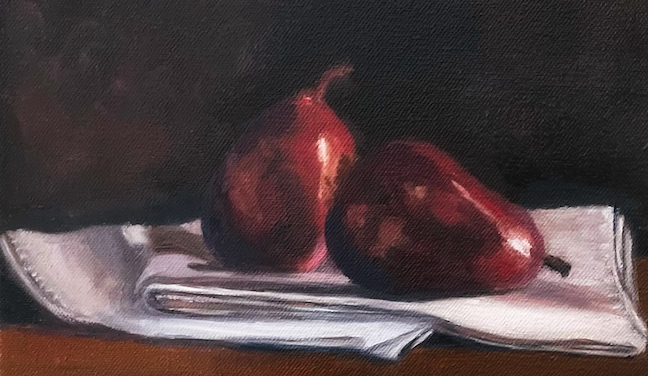
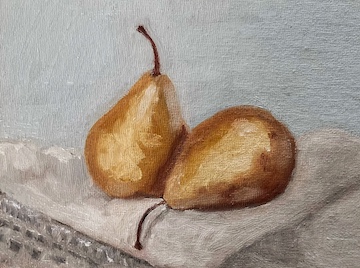
The fruit tree heard that the Bhagavad Gita recommends surrendering the fruits of action to God and so he gently dropped his pears into Mother Earth’s lap.
Because he did so, pear seeds made the world much more pear-treed.
from Bhagavad Gita: Chapter 5
An Italian proverb states, “in bocca chiusa non cade pera,” – a pear will never fall into a closed mouth. But, to me, there is something about the shape, color, and texture of a pear that makes it almost too beautiful to eat!
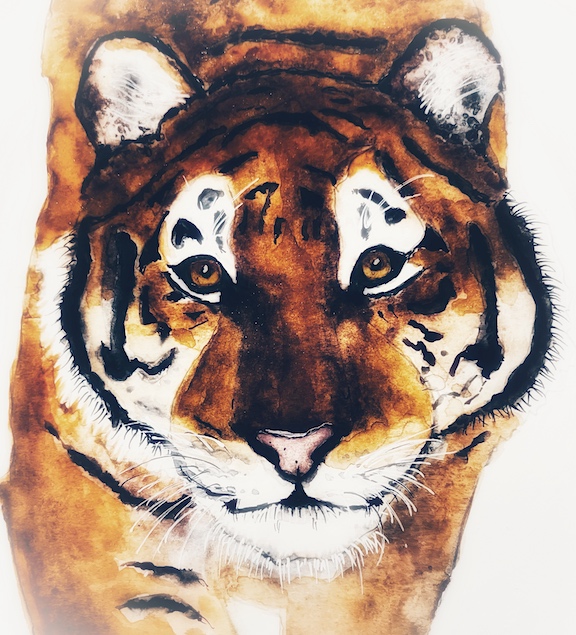
Tyger Tyger, burning bright, In the forests of the night; What immortal hand or eye, Could frame thy fearful symmetry?
In what distant deeps or skies. Burnt the fire of thine eyes? On what wings dare he aspire? What the hand, dare seize the fire?
And what shoulder, & what art, Could twist the sinews of thy heart? And when thy heart began to beat. What dread hand? & what dread feet?
What the hammer? what the chain, In what furnace was thy brain? What the anvil? what dread grasp. Dare its deadly terrors clasp?
When the stars threw down their spears And water’d heaven with their tears: Did he smile his work to see? Did he who made the Lamb make thee?
Tyger Tyger burning bright, In the forests of the night: What immortal hand or eye, Dare frame thy fearful symmetry?
I love to listen to audiobooks while I needlepoint or paint with watercolors. This week’s book by John Lithgow, The Poet’s Corner: The One-and-Only Poetry Book for the Whole Family, gave me six and a half hours of pure bliss! The author included recitations, biographical information, and analyses of over forty poets’ content, style, and language. William Blake’s “The Tyger” poem was included in the list and inspired my blogpost.
P.S. I continued thinking about tigers and wild cats in general these last few days and when I came across Rudyard Kipling’s book, Just So Stories, I couldn’t resist rereading a story from my childhood, “How the Leopard Got His Spots.” You might enjoy it, too!
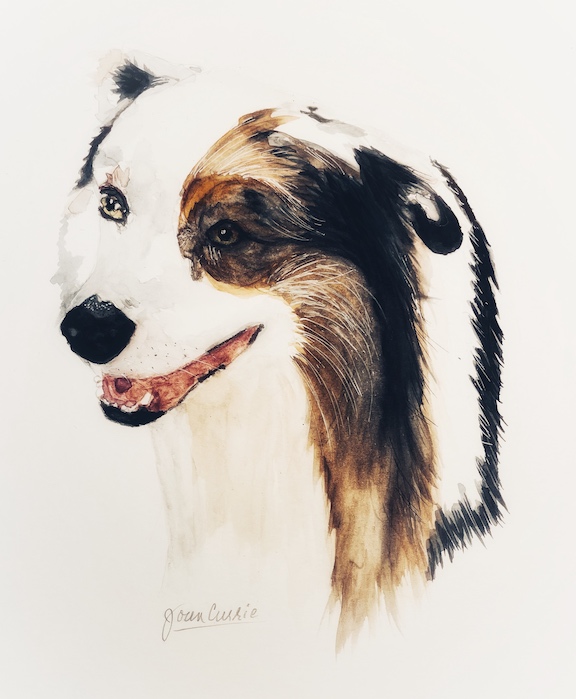
In Reykjavik’s streets, where legends roam, Anita, like a star, found her home. With fur of black and white, a beauty rare, A brown circle ’round her eye, beyond compare.
Energetic and alert, she caught my eye, A playful spirit, reaching for the sky. In her gaze, a spark, like twinkling stars, I wished to take her home, to be mine.
Though now a pet, her spirit’s still free, Anita, the Icelandic dog, with glee. With every wag of her tail, a tale unfurled, In my heart, she’ll forever be cherished, this world.
I admired this Icelandic Sheepdog in Reykjavik’s city center. Her name is Anita, after the Icelandic actress, Anita Briem. Oddly, she was only one of two pet dogs I saw in Iceland during my eight-day stay there. This breed dates back to the 800s when humans first came to Iceland. Anita seemed very eager and lively – I am sure she would have been a good sheep herder.
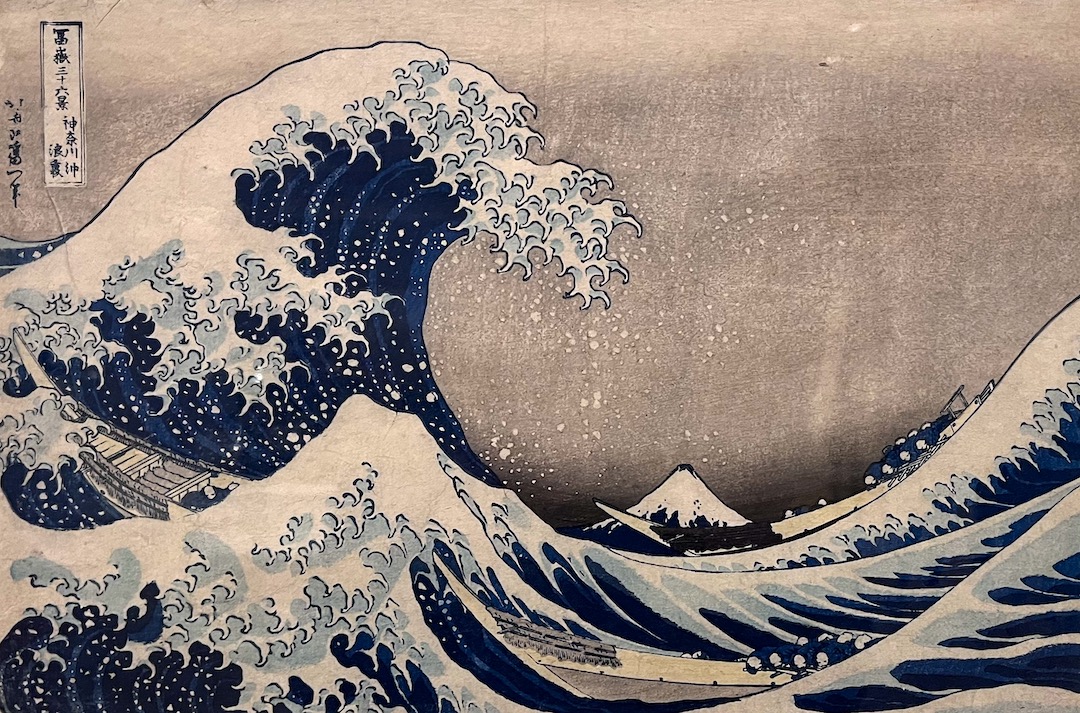
Photographed by Joan Currie at the Seattle Art Museum – The Great Wave off Kanagawaby Hokusai
During the Ebo period, ukiyo-e, woodblock prints became enormously popular. Sold in small shops and on the street, an ordinary print went for the price of a bowl of noodles. People of very modest income, therefore, could collect prints in albums or paste them on their walls. A highly efficient production system made this wide distribution of Japanese graphic art possible. From Gardner’s Art Through the Ages
It was thrilling to see The Great Wave, pictured above, at the Seattle Art Museum exhibit featuring the Japanese artist, Katsushika Hokusai (葛飾 北斎, c. 31 October 1760 – 10 May 1849). He is celebrated for having created approxiamtely 30,000 woodblock prints, paintings, illustrations, and sketches during his lifetime.
As this year hurtles towards its end, I thought of Hokusai’s Great Wave, and found myself amidst a sea of unfinished tasks and uncharted waters. Like the towering wave, these last few days of 2023 have loomed large, yet I am carried forth by the inexorable force of time.
As I look at the intricate details of Hokusai’s work, I see parallels in my own year-end reflections. The waves symbolize exquisite beauty, contrasts of dark and light, highs and lows, dynamism, chaos, and complexities of life, while the boats – the challenges I have faced throughout the year (a little trying to stay afloat but mostly enjoying the ride!).
I look forward to catching a new Great Wave in 2024!
Fall, leaves, fall; die, flowers, away; Lengthen night and shorten day; Every leaf speaks bliss to me Fluttering from the autumn tree. I shall smile when wreaths of snow Blossom where the rose should grow; I shall sing when night’s decay Ushers in a drearier day. From Fall, Leaves, Fall by Emily Brontë
I reveled in the beauty of fall on my walk – but, there was a bittersweet undertone to the experience. The leaves that carpeted my path were a sign that the world around me was preparing for a long slumber. The once-bustling woods would soon be hushed by the frigid grip of winter. The trees, now so alive with color, will soon stand bare and vulnerable.